

Where Did The 67 Signal Repair Company Serve In World
| Habitation Counties Divisional Telegraph Company 44th (Home Counties) Bounded Signals 44 (Home Counties) Signal Regiment 44 (Cinque Ports) Signal Squadron | |
|---|---|
 Badge of the Royal Corps of Signals | |
| Agile | 1908–2009 |
| Country |  United Kingdom United Kingdom |
| Branch |  Territorial Army Territorial Army |
| Role | Signals |
| Role of | 44th (Domicile Counties) Division 67th (2nd Home Counties) Division 12th (Eastern) Infantry Sectionalization 36 (Eastern) Bespeak Regiment |
| Garrison/HQ | Brighton Ravensourt Park Grays |
| Engagements | Beginning Earth War:
Second World State of war:
|
44 (Home Counties) Signal Regiment was a Territorial Ground forces (TA) unit of the British Ground forces'south Royal Corps of Signals. It had its origins in a Volunteer unit of the Royal Engineers (RE) formed in the 1890s. Information technology provided the bounded signals for the 44th (Home Counties) Segmentation and its duplicates in both World Wars, besides seeing agile service with 28th Sectionalization in the Offset World War. Its successor connected in the postwar TA and Army Reserve.
Origin [edit]
When the Volunteer Force was subsumed into the new Territorial Force (TF) under the Haldane Reforms in 1908, the onetime 1st Sussex Engineer Volunteer Corps provided the bounded engineers for the TF's Home Counties Division, including the Home Counties Bounded Telegraph Company with the following organisation:[1] [2] [3] [four] [5] [6]
- Company Headquarters at 23 Gloucester Place, Brighton
- No 1 Section at Brighton
- No 2 (Surrey) Section
- No three (Kent) Section
- No iv (Middlesex) Section
Nos 2–4 Sections were attached to and largely manned by the 3 infantry brigades of the division. The Telegraph Visitor was redesignated a Signal Visitor in 1911.[v] [ii]
Kickoff Globe War [edit]
Mobilisation [edit]
The Indicate Company had been with the Dwelling house Counties Sectionalisation on Salisbury Plain for its annual training when the order came to mobilise on 4 August 1914. The unit returned to Brighton and was embodied the post-obit 24-hour interval. Soon after, TF units were invited to volunteer for overseas service. Early in September battalions of the Home Counties Division began to save Regular units at Gibraltar, then in October the infantry and arms of the whole division embarked for garrison service in India. Although it did later receive a number (44th), the Home Counties Partition never operated as a formation during the state of war: its units remained scattered in colonial garrisons or were fastened to Indian divisions. The Divisional RE remained in England to support Regular formations: the Signal Company joined the 28th Sectionalization, which was forming at Winchester primarily from units returned from service in India.[seven] [8] [9]
On 31 August, the germination of a reserve or 2d Line unit of measurement was authorised for each 1st Line unit where 60 per cent or more of the men had volunteered for Overseas Service. The titles of these 2nd Line units would exist the aforementioned every bit the original, only distinguished by a 'ii' prefix. In this manner duplicate battalions, brigades and divisions were created, mirroring those TF formations being sent overseas. After 3rd Line units were formed to supply drafts to the 1st and second Lines.[10]

Formation sign of the 28th Partition, a strip of blood-red material on the shoulder strap.
1st Abode Counties Signal Company [edit]
1st Abode Counties Signal Visitor joined 28th Sectionalization at Winchester on 5 January 1915 and provided its communications until beyond the end of the state of war.[2] [7] [8] [9] [eleven] [12] The division embarked at Southampton fifteen–eighteen January, disembarking at Le Havre 16–xix January, and concentrated between Bailleul and Hazebrouck by 22 January. While on the Western Front information technology participated in the post-obit actions:[11]
- Battle of Gravenstafel Ridge (22–23 April)
- Boxing of St Julien (24 April–four May)
- Boxing of Frezenberg Ridge (eight–13 May)
- Battle of Bellewaarde Ridge (24–25 May)
- Boxing of Loos (27 September–five October)
At noon on 19 Oct 1915 the sectionalization was ordered to leave for an unknown destination within 48 hours. The Signals Company entrained on 20 October, embarked at Marseille on 24 October and arrived at Alexandria in Arab republic of egypt on 29 October. The division and then embarked again for the Macedonian front, the Signal Visitor arriving at Salonika on 16 Dec 1915, joining the partitioning on the River Struma.[9] [11]
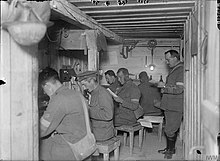
An RE Signal Visitor at work on the Western Front.
28th Division spent the rest of the state of war on this front, where in that location were few major deportment, but the troops suffered steady attrition through trench warfare casualties and sickness. A year after its arrival it took part in the occupation of Mazirko and the capture of Bairakli Jum'a. In May 1917 it captured Ferdie and Essex Trenches nigh Bairakli Jum'a, and in October information technology captured Nairakli and Kumli. Finally, on 18 and 19 September 1918, 28th Partitioning took part in the Battle of Doiran and the subsequent pursuit of the defeated Bulgarian Ground forces upwardly the Strumica Valley. On 29 September Bulgaria concluded the Armistice of Salonica with the Allies. This was followed a month later past the Armistice of Mudros with the Turks. Early in November the 28th Division was sent to occupy Constantinople and the Dardanelles Forts, with Divisional HQ at Chanak (Çanakkale).[9] [11]
28th Division remained in these positions, though its units (including 28th Divisional Signal Company of the new Royal Corps of Signals) were progressively manned by Regulars subsequently the remaining TF men were demobilised. In July 1922, 28th Division was moved to interpose between the Greek and Turkish armies (the Chanak Crisis). After a ceasefire was arranged, the British troops were progressively reduced. On ii October 1923 the concluding evacuation took place, and 28th Partitioning was disbanded.[nine] [11]
second Dwelling house Counties Signal Visitor [edit]
2nd Home Counties Indicate Co was formed at Brighton and the 2nd Habitation Counties Sectionalization began to assemble around Windsor in Nov 1914. There was a shortage of equipment with which to train – merely a few old .256-in Japanese Ariska rifles were available. In July 1915 the units had to be reorganised as TF men who had merely signed up for Home Service were transferred to Home Defense brigades (termed Conditional Brigades). A few Habitation Counties men probably joined 9th Provisional Signal Department in 9th Provisional Brigade, formed in Kent predominantly from Eastward Lancashire units. The 2d HC Segmentation was redesignated 67th (2nd Home Counties) Sectionalization in Baronial 1915 and the signal visitor became 67th (2nd HC) Point Co. In November the division became part of Second Regular army, Key Force, and was quartered in Kent, the Signal Co HQ located with divisional HQ (DHQ) at Canterbury. On nineteen January 1916 the sections left to join their corresponding brigades.[thirteen] [14]
67th (2nd HC) Division had the dual function of home defence and supplying drafts to units serving overseas. It was twice warned for service in Ireland and in April 1917 for service on the Western Front end, but these deployments never materialised and the sectionalization spent the whole war in England. During the winter of 1917–18 the division moved to Essex, where it joined XXIII Corps. DHQ and Signals were at Colchester. The units maintained these dispositions until later on the Ceasefire with Germany, when demobilisation began. In March 1919 the remaining RE units began to disband, and the process was shortly completed.[thirteen] [14]
Royal Signals [edit]
When the TF was reconstituted as the Territorial Army (TA) in 1920–1, a new 44th (Dwelling Counties) Divisional Signals [a] was formed by the newly-formed Imperial Corps of Signals (RCS). It combined the former 44th (HC) Point Company, RE, with 10th Battalion, Middlesex Regiment. Headquarters was at Stamford Brook Social club, Ravenscourt Park, Westward London (the former HQ of the 10th Middlesex), with ii Company at Brighton and sections at New Southgate, Chatham and Hurstpierpoint.[two] [iv] [16] [b]
By the 1930s, 44th (HC) Signals likewise administered:[five]
- 226th Field Artillery Bespeak Section, Drill Hall, Gloucester Road, Brighton
- 227th Field Arms Bespeak Department, Drill Hall, Hurstpierpoint, later at Drill Hall, Bognor Regis
- 203rd Medium Artillery Signal Section, Fort Pitt, Chatham
The 4th Cadet Battalion of the Middlesex Regiment was also attached to the unit of measurement.[5]
2nd World War [edit]
Mobilisation [edit]
Following the Munich Crisis the TA was doubled in size. Over again, 44th (HC) Division formed a duplicate, 12th (Eastern) Infantry Division, with its own divisional signals. 44th (HC) Division was mobilised on 3 September 1939 and twelfth (Due east) Division became agile on vii October 1939.[2] [18] [19] [xx]

44th (Home Counties) Division'due south formation sign.
44th (Abode Counties) Bounded Signals [edit]
44th (HC) Division embarked for French republic on 1 April 1940 to bring together the new British Expeditionary Force (BEF).[19]
Dunkirk [edit]
When the High german offensive in the due west opened on x May, the BEF advanced into Belgium in accordance with 'Plan D'. 44th (HC) Partition moved upwards to the Escaut, where it was in reserve.[21] Nevertheless, the German language Army broke through the Ardennes to the east, forcing the BEF to withdraw again, and by 19 May the whole strength was back across the Escaut.[22] 44th (HC) Division tried to hold the nearly dangerous point, but the Germans established bridgeheads across the Escaut at dawn on 20 May. The assault was renewed on 22 May and the segmentation was desperately chewed up, but there was no breakthrough: information technology was the deep penetration further east that forced the BEF to withdraw. Adjacent day the BEF fell dorsum to the 'Canal Line', and 44th (HC) Division was withdrawn into reserve.[23] [24] [25] [26]
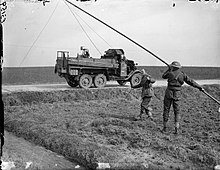
Imperial Signals erecting cable poles in France, 1940.
Cutting off, the BEF barbarous back towards the coast, with 44th (HC) Partition given the responsibility of defending the area circular Hazebrouck. On 26 May the decision was made to evacuate the BEF through Dunkirk (Operation Dynamo). 44th (HC) Segmentation was heavily attacked by German Panzer divisions on 27 May, but fought on adamantly until ordered to withdraw, by which time the enemy's advanced columns had penetrated betwixt its widely-spread units. With its flanks 'in the air' after neighbouring French formations retreated during the night of 28/29 May, the bounded commander decided to withdraw some 6 miles (ix.seven km) to Mont des Cats, a strong position held by the bounded artillery and some of the bounded RE acting as infantry, though only DHQ and scattered elements reached the Mont by dawn to join them. This rearguard was subjected to intense mortar burn adjacent morn, then by dive-bombing, but held its position for 30 hours while the balance of the division withdrew. The remnants of the partitioning reached the beaches for embarkation, reaching England on i June.[19] [27] [28] [29] [30] [31]
Home Defence [edit]
On return to England, 44th (HC) Division was briefly in Southern Command, then until October in North East England with I Corps before returning to invasion-threatened South East England with XII Corps. In April 1942 the division came under State of war Office control preparatory to going overseas, and on 29 May it embarked for Egypt.[19]
North Africa [edit]
44th (HC) Partitioning arrived in Arab republic of egypt on 24 July, presently afterwards 8th Ground forces had retreated to the El Alamein position. On 15 August it was assigned to Thirteen Corps before General Rommel attacked the El Alamein line (the Boxing of Alam el Halfa). The sectionalization held the Alam Halfa ridge when the assault came in on 30 August. Over the next ii days the Panzers made repeated attacks but 44th (HC) Division held its position and past iii September the partition was counter-attacking.[19] [32]
For Eighth Army's counter-offensive (the Second Boxing of Alamein), 44th (HC) Division was to lead one of Thirteen Corps' thrusts through the enemy minefields on the first night, 23/24 October (Operation Lightfoot). A road was found through the kickoff belt of minefields ('January') on the commencement night and 44th (HC) Sectionalisation succeeded in passing the second minefield ('February') the side by side dark, but the armour was unable to exploit beyond.[33] [34]
The 2d phase of the offensive, Operation Supercharge, was launched on the night of 27/28 October. Eventually, the armour broke though, and next 24-hour interval came signs that the enemy was withdrawing. 44th (HC) Division took some part in the pursuit to El Agheila, collecting prisoners, but XIII Corps was short of transport and was left behind as 8th Army collection westwards. Shortly after 44th (HC) Division HQ was disbanded, and its units distributed.[nineteen] [35] The personnel of 44th (HC) Divisional Signals were used to reinforce XXX Corps Signals, 7th Armoured Division Signals and No iv Line of Advice (LoC) Signals.[two] [4]

12th (Eastern) Bounded sign.
12th (Eastern) Divisional Signals [edit]
In Apr 1940, three of the new indistinguishable TA divisions under training, including the 12th (Eastern) Infantry Segmentation, were sent to French republic to act as labour troops to work on airfields and Lines of Advice (LoC). Elements of the divisional point unit went to France for the LoCs, but non the complete unit.[20] [36] On 17 May, later on the BEF was forced to withdraw from the Dyle Line, 12th (Due east) Sectionalization was ordered to concentrate in the neighbourhood of Amiens.[22] The infantry only had their personal small arms, and meagre artillery support had to be improvised. The following twenty-four hours the division was covering the of import traffic centres of Albert, Doullens, Amiens and Abbeville together with 2 equally ill-equipped brigades of 23rd (Northumbrian) Division, all under the commander of 12th (E) Division, Maj-Gen R.Fifty Petre and known as 'Petreforce'. Petreforce at the fourth dimension was the only thing between seven advancing Panzer divisions and the sea. The raw Territorials held up the German accelerate for v hours, allowing the BEF to keep its retreat towards Dunkirk.[23] [37]
The survivors of 12th (E) Division so made their way to the declension and got out of France through Dunkirk and other evacuation ports, the division finally reaching England on viii June. Its casualties were so severe that information technology was cleaved upwards on 10 July, with the divisional signals sending reinforcements to 44th (HC) Signals and 1 Army Signal Training Regiment in the UK and to the Middle East, including No 3 LoC Signals and Sudan Signals.[20] [two] [4]
Postwar [edit]
When the TA was reconstituted in 1947, the unit reformed at Gillingham, Kent, every bit 44 (Habitation Counties) Bounded Signal Regiment with the post-obit organisation:[2] [4]
- Regimental HQ at Stamford Brook
- 1 Squadron at Stamford Brook
- two Squadron at Brighton
- 3 Squadron at Chatham
In 1957, 2 Sqn moved to Bromley, just E, F and Chiliad Troops remained at Brighton and a new K troop was formed at Richmond-upon-Thames.[2]
When the TA was reorganised in 1961, the sectionalisation became 44th (Home Counties) Segmentation/District and the regiment absorbed the commune point unit, 62 (Mixed) Signal Regiment (Cinque Ports). This had been formed in Anti-Shipping Command in 1947 equally 11th AA (Mixed) Indicate Rgt from elements of the wartime 1 and 2 AA Group Signals. The subtitle 'Mixed' indicated that members of the Women's Purple Regular army Corps were integrated into the unit. Afterwards AA Command was disbanded in 1955 the regiment merged with 259 (Mixed) Heavy Anti-Aircraft Regiment, Royal Artillery, (Dwelling house Counties) (Cinque Ports). Based at Shorncliffe, the unit was numbered equally 62 Signal Rgt in 1959 and adopted the 'Cinque Ports' subtitle the following twelvemonth. The merged regiment also took this historic title, as 44 (Home Counties) Signal Regiment (Cinque Ports) [2] [38] The merged regiment also took on authoritative responsibleness for two brigade signal sqns in 44 (HC) Division:[ii] [39]
- 329 Sqn formed in 1959 at Bromley from 131 (Surrey) Infantry Bde Signals
- 330 Sqn formed in 1959 at Tunbridge Wells from 133 (Kent & Sussex) Infantry Bde Signals
When the TA was reduced into the Territorial and Ground forces Volunteer Reserve (TAVR) in 1967 the regiment became a single squadron (44 (Cinque Ports) Sqn) at Gillingham in 36 (Eastern) Bespeak Regiment. In March 1969 information technology formed 858 (Corps) Trp at Eastbourne and 859 Trp at Ilford, which moved to Eastbourne in 1970. The role of these Trps was to reinforce the Regular 22 Signal Rgt in British Army of the Rhine. These 2 Trps combined on thirty November 1977 to reform the disbanded 56 Indicate Sqn.[2] [40] [41]
In 1992 44 Sqn's HQ moved to Grays, Essex, and a sub-unit was formed at Prittlewell, Southend-on-Bounding main, from a troop from 70 (Essex Yeomanry) Betoken Sqn, a platoon of 10th Battalion, Parachute Regiment, and part of 215 Transport Sqn, Royal Corps of Transport, giving the following organisation:[2] [41]
- SHQ at Grays
- 747 and 748 Trps at Grays
- 746 and 749 Trps at Prittlewell
Nether the Strategic Review of Reserves in 2009, 36 (Eastern) Signal Rgt was reduced to 36 (Essex Yeomanry) Bespeak Sqn at Colchester, including 844 (Cinque Ports) Signal Troop.
Commanding Officers [edit]
Unit commanders included the post-obit:[5] [iv]
Home Counties Divisional Signal Co, RE:
- Capt H.C. Saunders, commissioned 25 January 1908
44th (Abode Counties) Bounded Signals:
- Lt-Col A.South. Angwin, DSO, MC, TD, 1920 (subsequently Col Sir Stanley Angwin, President of the Establishment of Electric Engineers[42])
- Lt-Col R.East. Coleman, OBE, TD, 1927
- Lt-Col F. Reid, MC, TD, 1932
- Lt-Col A.H. Read, TD, 1936
- Lt-Col L.H. Harris, 1939–40[43]
- Lt-Col F.1000. Morton, 1940–42
- Lt-Col R.F. Gandy, 1947
- Lt-Col D.N. Deakin 1950
- Lt-Col K.B. Baldwin, MBE, TD, 1951
- Lt-Col A.A. Bradshaw, 1955
12th (Eastern) Divisional Signals:
- Lt-Col F. Reid, MC, TD, 1939–40
Honorary Colonel [edit]
The following served as Honorary Colonel of the unit:[5]
- Lt-Col R.R. Kimmitt, OBE, TD, appointed 18 April 1928, retired five July 1933[44]
- Maj Frederick Keogh, TD, appointed 5 July 1933[44]
- Col John Sclater-Booth, 3rd Lord Basing, TD, appointed 29 October 1934
- Brig-Gen R.C.A. McCalmont, CVO, DSO, appointed xvi July 1937
- Brig Sir Lionel Harris, KBE, TD, old CO and Engineer-in-Chief, General Postal service Role, appointed 1950[43]
Footnotes [edit]
- ^ Divisional signal units of the Regal Signals 1920–45 were battalion-sized and commanded by a Lieutenant-Colonel; they were not termed 'regiments' until 1946.[xv]
- ^ In the 1920s the Purple Signals' journal, The Wire, was published from Stamford Brook Lodge.[5] [17]
Notes [edit]
- ^ Westlake, p. thirteen.
- ^ a b c d due east f thousand h i j k l k Lord & Watson, pp. 152–4.
- ^ Morling, pp. xix & 249.
- ^ a b c d e f Nalder, p. 598.
- ^ a b c d e f one thousand Monthly Army List, various dates.
- ^ London Gazette', 20 March 1908.
- ^ a b Becke, Pt 2a, pp. 49–54.
- ^ a b 44 Division at Long, Long Trail.
- ^ a b c d eastward Morling, p. 35.
- ^ Becke, Pt 2b, p. 6.
- ^ a b c d e Becke, Pt 1, pp. 106–sixteen.
- ^ Lord & Watson, p. 222.
- ^ a b Becke, Pt 2b, pp. 75–82.
- ^ a b Morling, pp. 36–seven.
- ^ Lord & Watson, p. 21.
- ^ "10th Middlesex at Regiments.org". Archived from the original on 2005-12-27. Retrieved 2005-12-27 .
- ^ The Wire archive at Royal Signals Museum.
- ^ Eastern Command 3 September 1939 at Patriot Files.
- ^ a b c d eastward f Joslen, pp. 71–two.
- ^ a b c Joslen, p. 56.
- ^ Ellis, France & Flanders, Chapter III.
- ^ a b Ellis, France & Flemish region, Affiliate 4.
- ^ a b Ellis, French republic & Flemish region, Affiliate V.
- ^ Ellis, France & Flanders, Chapter VI.
- ^ Ellis, French republic & Flanders, Chapter 7.
- ^ Ellis, France & Flanders, Chapter Eight.
- ^ Ellis, France & Flemish region, Affiliate IX.
- ^ Ellis, France & Flanders, Affiliate Xi.
- ^ Ellis, France & Flanders, Affiliate XII.
- ^ Ellis, French republic & Flemish region, Chapter Thirteen.
- ^ Ellis, France & Flanders, Chapter Xiv.
- ^ Playfair, Vol 3, pp. 384–90.
- ^ Joslen, p. 570.
- ^ Playfair & Molony, Vol IV, pp. 42–iii, 46–seven.
- ^ Playfair & Molony, Vol IV, pp. 92–3; 220.
- ^ Ellis, France & Flanders, Chapter Two.
- ^ Butler & Bradford, pp. 96–vii, 106.
- ^ Nalder, pp. 617–8.
- ^ Lord & Watson, p. 205.
- ^ Lord & Watson, pp 168–lxx.
- ^ a b "36 Bespeak Rgt at Regiments.org". Archived from the original on 2006-01-04. Retrieved 2006-01-04 .
- ^ Nalder, Appendix 3, p. 505.
- ^ a b Nalder, Appendix 3, p. 531.
- ^ a b London Gazette, 4 July 1933.
References [edit]
- Maj A.F. Becke,History of the Great War: Lodge of Battle of Divisions, Part i: The Regular British Divisions, London: HM Jotter Part, 1934/Uckfield: Naval & Military Printing, 2007, ISBN 1-847347-38-X.
- Maj A.F. Becke,History of the Great War: Guild of Boxing of Divisions, Office 2a: The Territorial Force Mounted Divisions and the 1st-Line Territorial Force Divisions (42–56), London: HM Stationery Office, 1935/Uckfield: Naval & Military Press, 2007, ISBN ane-847347-39-eight.
- Maj A.F. Becke,History of the Great State of war: Order of Battle of Divisions, Office 2b: The 2nd-Line Territorial Strength Divisions (57th–69th), with the Home-Service Divisions (71st–73rd) and 74th and 75th Divisions, London: HM Jotter Office, 1937/Uckfield: Naval & Armed forces Press, 2007, ISBN ane-847347-39-8.
- Lt-Col Ewan Butler & Maj J.S. Bradford, The Story of Dunkirk, London: Hutchinson/Arrow, nd.
- Maj L.F. Ellis, History of the Second Earth War, United Kingdom Military machine Serial: The War in French republic and Flemish region 1939–1940, London: HM Stationery Office, 1954/Uckfield, Naval & Military Printing, 2004.
- Joslen, H. F. (2003) [1990]. Orders of Boxing: Second Globe War, 1939–1945. Uckfield, East Sussex: Naval and Military Press. ISBN978-one-84342-474-1.
- Cliff Lord & Graham Watson, Royal Corps of Signals: Unit Histories of the Corps (1920–2001) and its Antecedents, Solihull: Helion, 2003, ISBN 1-874622-92-two.
- Col L.F. Morling, Sussex Sappers: A History of the Sussex Volunteer and Territorial Ground forces Regal Engineer Units from 1890 to 1967, Seaford: 208th Field Co, RE/Christians–W.J. Offord, 1972.
- Maj-Gen R.F.H. Nalder, The Regal Corps of Signals: A History of its Antecedents and Developments (Circa 1800–1955), London: Royal Signals Institution, 1958.
- Maj-Gen I.South.O. Playfair, History of the Second Earth War, United Kingdom Military Series: The Mediterranean and Center East, Vol Iii: (September 1941 to September 1942) British Fortunes reach their Everyman Ebb, London: HMSO, 1960 /Uckfield, Naval & Military Press, 2004, ISBN i-845740-67-X
- Maj-Gen I.S.O. Playfair & Brig C.J.C. Molony, "History of the Second World War, Great britain Military Series: The Mediterranean and Middle Eastward, Vol IV: The Destruction of the Axis forces in Africa, London: HMSO, 1966/Uckfield, Naval & Military Press, 2004, ISBN one-845740-68-8
- R.A. Westlake, Royal Engineers (Volunteers) 1859–1908, Wembley: R.A. Westlake, 1983, ISBN 0-9508530-0-3.
External sources [edit]
- The Long, Long Trail
- Orders of Battle at Patriot Files
- Land Forces of Britain, the Empire and Commonwealth – Regiments.org (annal site)

Source: https://en.wikipedia.org/wiki/44th_(Home_Counties)_Signal_Regiment
Posted by: montgomeryletyle.blogspot.com
0 Response to "Where Did The 67 Signal Repair Company Serve In World"
Post a Comment